

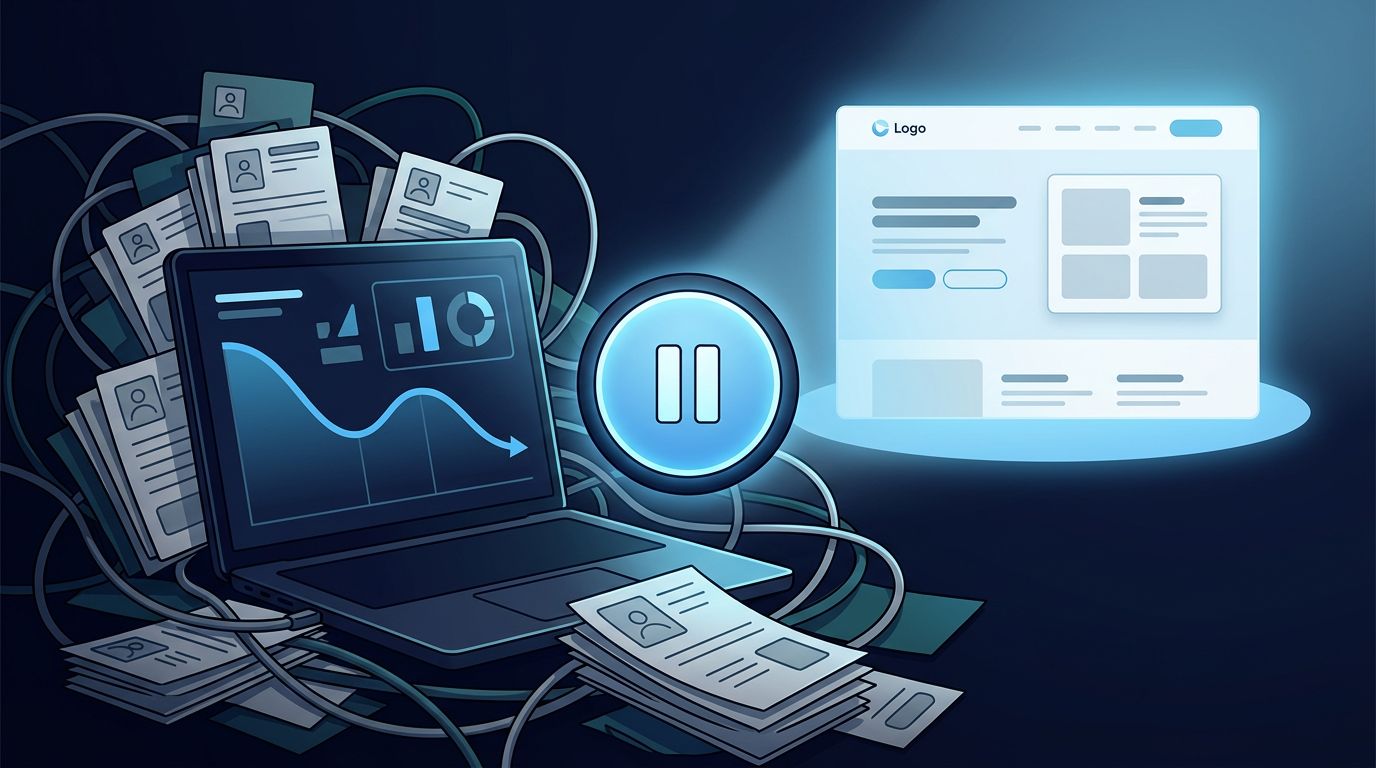
Publishing another blog post feels like progress. It fills the content calendar, gives the team a clean deliverable, and makes the marketing engine sound busy.
But a SaaS content strategy can turn into a factory for pages nobody needs. Before publishing more, ask what the existing library is doing. Does it serve your ideal customer profile, create a measurable business outcome, and deserve more investment? If new posts don’t earn attention, trust, or pipeline, more volume won’t rescue the plan. It’ll only make the mess bigger.
Stopping new publishing isn’t giving up on content. It’s an allocation decision, and your next useful move might be fixing what you’ve already built.
Key Takeaways for SaaS Content Strategy
- Pause your content marketing strategy when the library has decaying, duplicated, or commercially disconnected assets. Update use case pages, product information, conversion paths, and other unfinished work before creating another top-of-funnel post.
- Treat traffic as a clue, not the finish line. Track product sign-ups, trial starts, qualified demos, activated accounts, pipeline, and retained revenue to see whether content is doing its job.
- Keep publishing when you have something competitors can’t cheaply copy. First-party data, implementation lessons, customer stories, and real product experience still earn attention in search and AI answers.
A pause needs explicit content marketing goals, a named owner, and a deadline. Otherwise, it becomes the kind of “strategic reset” that quietly turns into six months of nobody owning the blog.
When Your SaaS Blog Needs a Publishing Pause
The decision isn’t about whether blogging is dead. It’s about whether your current production line is creating useful assets or fresh clutter.
A blog with 300 thin, overlapping articles isn’t an asset. It’s a garage full of unopened boxes.

Your New Ideas Sound Like Old Ideas
Take a hard look at the backlog. If it is packed with “What Is…”, “How to…”, and generic list posts that could fit any software company, hit pause.
Search engine optimization is changing because search results and AI answers increasingly satisfy interchangeable definitions. Those queries once brought reliable top-of-funnel traffic. Now, many are answered directly in search results and AI Overviews. A 2026 study of AI Overviews and Wikipedia traffic estimated a 15% decline in daily traffic to affected English articles.
That doesn’t mean informational content is useless. It means the generic answer is becoming a commodity. When your team has real product or customer evidence, replace the definition with useful use case pages. Otherwise, don’t publish another reheated answer.
The Blog Has No Route to Revenue
A post can rank, attract thousands of visitors, and still produce nothing but a cheerful line chart. Brutal, but common.
Pause when organic website traffic keeps rising while product sign-ups, demo requests, and activated users stay flat. Also pause when the same pages have been “almost converting” for months. Hope isn’t a reporting category.
For B2B SaaS companies, content has to meet people in a real buying moment. Judge each proposed page against your ideal customer profile. Prioritize bottom of funnel topics, including category pages built around software category keywords, competitor alternatives, integration guides, and detailed use case pages. It won’t always look glamorous. It will look useful.
Audit the Library Before Creating More Work
Most content teams don’t have an output problem. They have a decision problem. A content marketing strategy needs a content lifecycle strategy, so every page has a defined next action.
That reluctance is understandable. It is also expensive.

Sort Every Meaningful Page Into Four Buckets
Start with content performance signals: pages that once had traction, pages with declining rankings, and use case pages closest to trials or demos. Use keyword research tools to check whether important software category keywords still match current demand and page quality. You don’t need a dramatic sitewide purge on a Tuesday afternoon.
Give each page one honest outcome:
- Keep it when it answers the query well, earns qualified visitors, and supports the buyer journey.
- Update it when the premise is sound but the examples, screenshots, product details, or competitive context are stale.
- Merge it when several posts fight for the same search intent and leave readers with fragments.
- Remove or deindex it when it is thin, inaccurate, duplicative, or has no realistic path back to usefulness.
Google’s people-first content guidance asks a better question than “Can we rank for this?” Ask whether someone who lands on the page leaves with enough to make progress.
Find the Pages Worth Saving
Don’t refresh an article by changing the publish date, swapping three adjectives, and calling it a resurrection. Readers can smell that move from space.
Bring in the things your company knows because it has lived them. A substantive refresh becomes product-led content when it adds product screenshots showing a real workflow. Include implementation details, customer language from calls, and clear trade-offs.
A strong refresh can also turn a broad educational post into a product-adjacent resource or strengthen use case pages with real workflow evidence. A guide on project intake, for example, becomes more useful when it shows how teams set up approvals and templates. It can also show ownership and reporting inside the tools they use.
What Still Deserves a New Blog Post
A publishing pause isn’t a vow of silence. It’s a filter for your content marketing strategy, deciding which topics earn a place. The point is to stop making posts because the calendar has an empty Tuesday.
Publish Where Your Product Has Earned an Opinion
Your best new topics usually sit close to an expensive customer problem, especially for readers at the bottom of funnel. They answer questions a buyer asks while comparing options, setting up a workflow, or trying to fix something that broke at 4:47 p.m. The strongest use case pages make those problems concrete, showing the stakes and a practical path forward.
Think software category keywords, integration pages, migration guides, use case pages, and honest competitor alternatives. Ahrefs has long built much of its organic growth around practical SEO problems its product can help solve, a focused approach that compounds topical authority. Zapier does something similar with automation workflows that make the tool feel concrete before the reader ever starts a trial.
The product shouldn’t crash through the paragraph wearing a sandwich board. Product-led content should teach a workflow through the product because it belongs in the solution, not because it’s an advertisement.
Build Content AI Systems Can Actually Cite
AI search has made broad, interchangeable content less attractive. A language model can summarize “how to improve team productivity” before your page gets a chance to say hello.
Give it material worth referencing instead. Publish original survey results. Build use case pages around original workflow evidence from your support team. Quote named customers with permission. Show where a popular approach fails, then show the fix.
This is where a SaaS content strategy gets more human, not less. Evidence-backed use case pages stand apart from interchangeable generic guides because they offer a point of view grounded in real work. That’s thought leadership with receipts, not a vague brand claim.
Measure Content by What Happens After the Click
Judge a content marketing strategy by whether content performance meets defined content marketing goals, not by pageviews alone.
Pageviews are easy to find and weirdly hard to quit. They’re also a poor reason to keep paying writers, designers, and subject-matter experts.
Track the Conversion Chain
In Google Analytics 4, mark the actions that matter as conversions: trial registrations, demo requests, paid upgrades, and qualified lead submissions for lead generation. Use marketing analytics to evaluate a realistic content distribution plan, with Google Analytics tools connecting channel activity to the customer journey. Setup still has to match your actual funnel.
Then connect web behavior to product analytics and CRM data. Track activated accounts, sales opportunities, annual recurring revenue, customer retention, and customer acquisition cost by content group.
A reader may not convert on their first visit, even when organic website traffic is rising, and that’s normal. What isn’t normal is treating every visitor like a win when none of them become customers.
Give Content a Fair Test, Then Make a Call
Use a window that fits your sales cycle: a self-serve tool may show meaningful signals in 30 days. B2B SaaS companies may need 90 days or longer before pipeline appears.
Review content by intent, audience, and topic cluster, not as one giant blog number. Group results around software category keywords and your ideal customer profile. Bottom of funnel pages, including use case pages, should earn conversion activity; broader educational pages may support branded search, email subscribers, or assisted conversions. After a fair test, compare page-type cohorts, including use case pages, and move the budget if a group does none of those things.
Content marketing ROI is allowed to be complicated. It is not allowed to be invisible.
FAQs About SaaS Content Strategy
Should a SaaS Stop Blogging Completely?
Usually, no. Stop publishing low-value posts, not useful ideas. Keep creating when you can share original data, customer experience, practical product education, or timely market insight tied to a business goal.
How Long Should a Publishing Pause Last?
Set a defined four-to-eight-week sprint. Use it to audit existing pages, update high-potential assets, fix conversion paths, and choose new topics that earn their place.
Which Posts Should We Update First?
Start with pages ranking on page two or three, attracting qualified visits, or sitting near a trial or demo conversion. Prioritize use case pages when they support that next step. Improve the proof, clarify the reader’s need, and strengthen the next action.
Publish Less, Prove More
The blog calendar isn’t a measure of ambition. The business outcome is.
A smaller library packed with useful, defensible content, such as use case pages, will beat a warehouse of generic posts built for traffic. That traffic rarely turns into trust. Stop publishing when the next article is only more noise, then put that energy into a repeatable content lifecycle strategy so useful work can finally compound.
Leave a Reply